
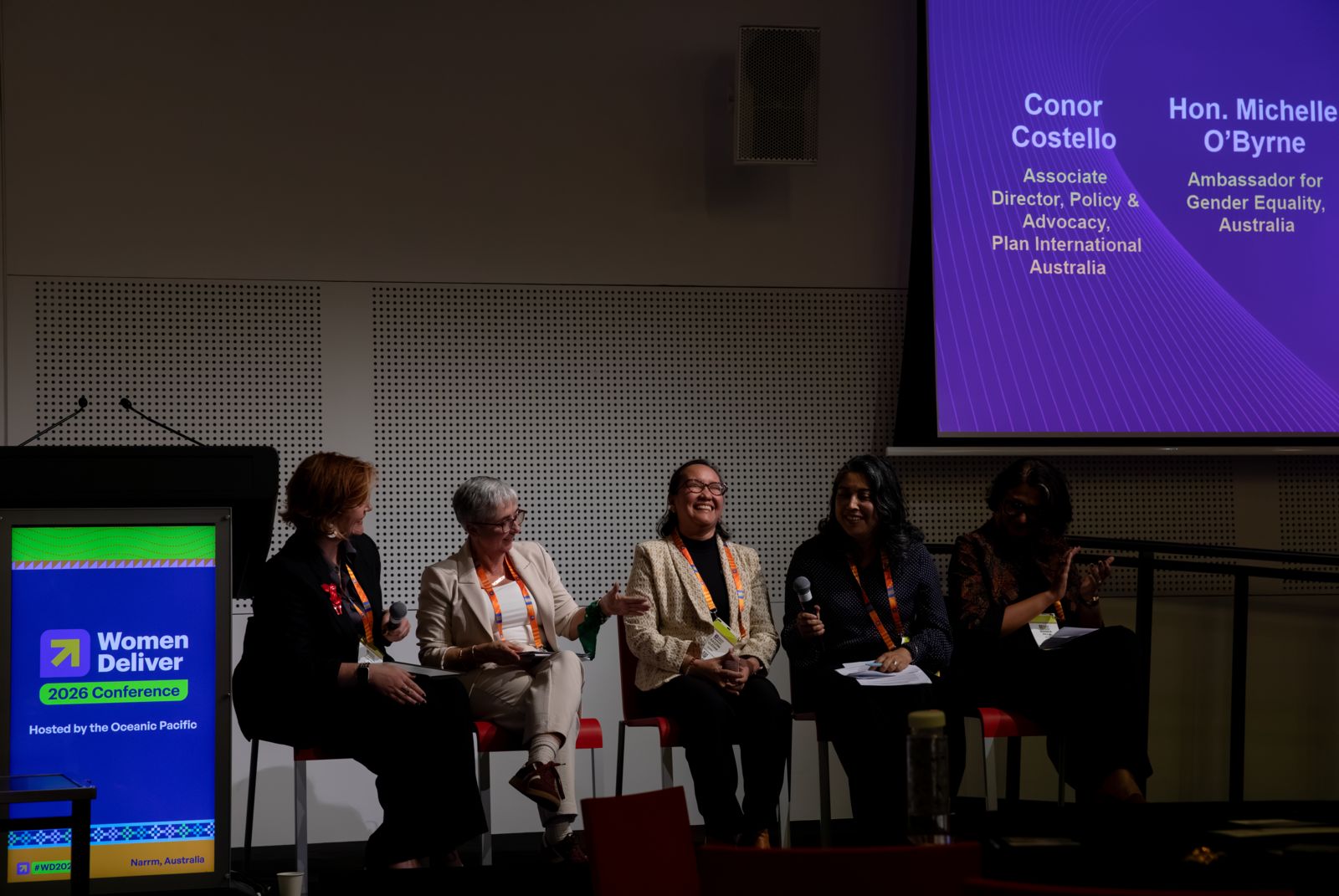
In April 2026, more than 6,000 delegates from 189 countries gathered in Melbourne for Women Deliver 2026. Here, a global movement came together to confront shrinking civic space and a development landscape marked by austerity. At the conference, the Guttmacher Institute released Just the Numbers: Australia’s Support for Global Sexual and Reproductive Health and Rights, a report quantifying the impact of Australia’s investment at a moment when global funding is collapsing.
The findings are stark. Across Asia and the Pacific, 27.7 million women wanting to avoid pregnancy lack access to contraception. A full third of these women reside in low- and middle‑income countries where inequality and fragile health systems continue to deny women bodily autonomy and sufficient healthcare. However, countries like Australia are well-placed to address this injustice and advance women’s health and rights across the region. Investments by Australia in 2024 enabled 2.8 million people to access contraception, preventing 830,000 unintended pregnancies, 303,000 unsafe abortions, and 588 maternal deaths.
These are extraordinary returns for a relatively modest investment, and despite the report’s title, they are more than just numbers. Australia’s investment in sexual and reproductive health and rights (SRHR) supports greater choice, autonomy, and frontline support for women and girls experiencing abuse. These numbers represent the chance for countless individuals to break free from reproductive coercion and, ultimately, lives saved.
The positive impact of investment in sexual and reproductive health, particularly for marginalized women, is clear in the Guttmacher report. However, as many attendees of Women Deliver 2026 emphasized throughout the conference, the global funding landscape for this crucial work has become increasingly fragile.
Frontline realities in Timor-Leste and Papua New Guinea
MSI Reproductive Choices is the largest provider of sexual and reproductive healthcare in Timor-Leste and Papua New Guinea. MSI’s workers traverse significant cultural and geographical barriers to put gender equality into practice and advance women’s rights across the region.
“MSI is able to reach those places where others cannot go,” says Nancy Hombo, the GEDSI (gender equality, disability and social inclusion) manager for MSI Papua New Guinea. Her team travels through tribal conflict zones and remote highlands to provide care in areas devoid of state services. Dr. Petronela Ribeiro, a clinic doctor with MSI Timor‑Leste, describes a similar landscape. Roads wash out in heavy rains. Landslides cut off remote villages. Outreach teams must cross rivers on foot while carrying medical supplies. “It’s very, very dangerous,” Dr. Ribeiro says. “Sometimes it’s hard for them to reach the facility . . . especially in rural areas.”
Organizations like MSI Reproductive Choices are filling a crucial gap for marginalized women. However, the sustainability of such healthcare services is far from guaranteed as many countries continue to drastically reduce the overseas development aid (ODA) on which these organizations depend. “I couldn’t imagine if MSI wasn’t there,” says Dr. Ribeiro. “It would be hard for women to access services and healthcare facilities.”
A collapsing funding landscape
The Guttmacher report warns of a widening gap between need and funding. It estimates that an additional AUD$82 billion investment was required to meet women’s sexual and reproductive health needs across low- and middle-income countries in 2024. Since then, this financing gap has only increased as nations decimate ODA. At the Women Deliver conference, former Australian prime minister Julia Gillard called out the significant decline, citing OECD findings of a 23.1% cut in 2024 alone.
“This is funding that was dedicated to health, education, and sexual and reproductive rights that saves and improves lives in the poorest places on our planet,” Gillard says. “For the first time ever, the five largest donors—the US, Germany, UK, Japan, and France—all cut their budgets simultaneously. . . . The United States alone accounted for a staggering 56.9% of the cut.”
Meanwhile, new US bilateral health agreements are pulling resources away from SRHR. Dr. Elizabeth Sully raised significant concerns, highlighting that misinterpretation of the expanded gag rule is already constraining services. “Women and women’s rights, SRHR are not on the agenda,” Dr. Sully argues. These restrictions are symptomatic of a global system where accountability is fading, gender equality is sidelined, and women’s rights are quietly being eroded.
Dr. Maliha Khan, the CEO of Women Deliver, paints a stark picture of the current situation: “The system that housed our victories created a model of dependency, making millions reliant on donors and organizations headquartered thousands of miles away rather than building the conditions for states to be held accountable to the people.”
The Melbourne Declaration for Gender Equality conveys these structural failings. As a collective, global call to action, it advocates for a greater focus on states’ human rights obligations and empowering local civil society to hold states accountable.
The Melbourne Declaration argues that the current philanthropy-focused model does not sufficiently deliver accountability to the people and too often forces international non-governmental organizations to carry the responsibility of states to provide essential services.
A rights‑based path forward: shifting power and restoring accountability
Advocates, researchers, and frontline workers are calling for a fundamental shift of power: for governments to fulfill their obligations to advance social justice and human rights by investing in local leadership and grassroots organizations to guide decision-making. This means solutions funded by the state but driven by the people.
“We really need to decenter the power in handling projects,” says Dr. Radzini Oledan, from the Center for Health Solutions & Innovations Philippines. Dr. Oledan points toward the Australian government’s RESPOND and SPRINT programs—organized in partnership with the International Planned Parenthood Federation—as positive steps toward directing resources to the people.
Through the work of women across the Oceanic Pacific, it’s clear that sustained funding for SRHR is a life-saving, essential component of gender equality. But governments must invest directly in locally led feminist organizations—and they must fulfill their human rights obligations.