
As the global community debates the unregulated rise of artificial intelligence and the expansion of digital surveillance, it is overlooking a crisis in the Global South. In South Asia, authoritarian states are already implementing technological control to devastate marginalized groups. For the region’s transgender and gender-diverse communities, digital platforms are essential lifelines for visibility and connection. However, state governments are rapidly turning these spaces against those who rely on them by weaponizing vague cyber laws to suppress advocacy and ignoring severe online harassment.
The resulting system of surveillance functions as a digital panopticon that simultaneously restricts free speech, actively criminalizes transgender identity, and erases fundamental human rights. This reality exposes the formidable human cost of unchecked digital power and offers critical lessons in grassroots resilience against state-sanctioned erasure.
Legal architectures of control
States across South Asia enact their repression against gender minorities through a coherent legal architecture of control. Governments use deliberately vague “morality” and “security” clauses in national cyber laws to discipline digital gender expression. In Pakistan, the Prevention of Electronic Crimes Act, 2016 (PECA) grants the state sweeping powers to bypass judicial oversight and censor content deemed contrary to the “glory of Islam” or “public order, decency or morality.” In practice, this has been used to block queer and trans educational platforms, surveil community chat forums, and silence dissenting human rights defenders. Similarly, law enforcement and conservative factions in Bangladesh have leveraged the country’s Cyber Security Act, 2026, which criminalizes content that “hurts religious values,” to suppress LGBTQ+ advocacy and penalize trans and hijra individuals publishing under preferred identities. In Nepal, the Electronic Transactions Act, 2063 (2008), criminalizes electronic material deemed contrary to “public morality or decent behavior,” a vague statutory threshold the Cyber Bureau routinely deploys to undermine activists and chill online expressions of sexual and gender nonconformity.
These laws enshrine moral ambiguity and function as political tools to force transgender activists into severe self-censorship. Because simply advocating for basic human rights is now classed as a criminal threat to the national or religious fabric, activists must constantly sanitize their language and online presence to avoid triggering state backlash or dangerous accusations of blasphemy.
Digital threats and the erasure of anonymity
Compounding this legal repression is the systematic dismantling of digital anonymity, which exposes activists to serious digital threats and harassment. Deep packet inspection, mandatory biometric SIM registrations, and laws forcing the identification of information originators have effectively stripped away the digital veil that members of marginalized groups rely on for safety.
Without anonymity, transgender advocates face highly organized, targeted digital violence. Perpetrators increasingly use artificial intelligence to generate fake sexual images (deepfakes) that can be used to blackmail, extort, and silence gender-diverse individuals. In Pakistan and India, deepfakes force marginalized voices offline and enforce patriarchal social values. This technology-facilitated gender-based violence (TFGBV) jeopardizes the physical safety of activists and severely damages their mental health. Many choose to self-silence just to survive, and discourse and advocacy wither as a result. When the state surveils your every move and malicious actors can effortlessly manufacture digital “evidence” to destroy your reputation, the internet ceases to be a public square and instead becomes a panopticon.
Resilience through platform migration
South Asia’s transgender activists are not passive victims of these intersecting threats. In in-person interviews, transgender rights activists in South Asia facing severe surveillance and shrinking civic spaces revealed that they are employing sophisticated tactics of digital resilience. A primary strategy is platform migration: the tactical shifting of advocacy across different digital realms based on specific goals and levels of risk.
Activists must constantly balance the desired reach of their activities against the potential danger of exposure to the authorities. For example, when demanding political accountability, advocates frequently use public platforms like X (formerly Twitter) to tag lawmakers and police officials and demand immediate state action. In one instance, when local police refused to register a First Information Report (FIR) for a transgender rape survivor in Pakistan, an activist publicly tagged Salman Sufi, director general of the Punjab chief minister’s strategic reforms unit. Recognizing the political sensitivity and public visibility of the tag, Sufi intervened immediately, compelling the local police station to file the FIR and publicly reposting the update to confirm state compliance.
Meanwhile, for grassroots mobilization and community care, activists retreat to encrypted, decentralized spaces like WhatsApp. There, closed groups act as secure digital sanctuaries where community members can share real-time alerts and coordinate physical survival tactics away from the state's surveillance. In the face of imminent physical violence, doxxing campaigns, and arbitrary police detention, members of targeted communities can use private WhatsApp to broadcast immediate emergency alerts, dispatch paralegal support, and coordinate physical relocation to safe houses.
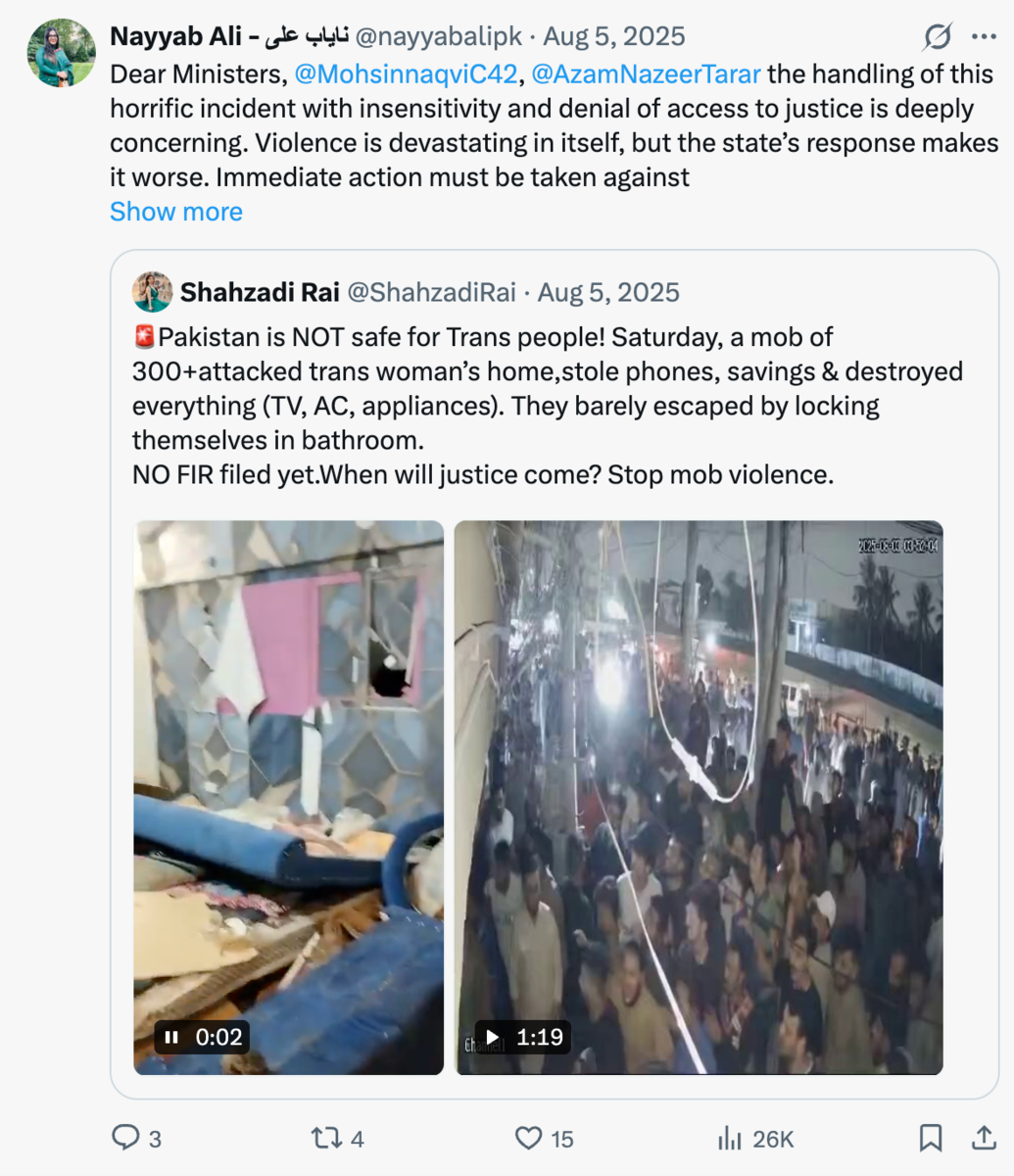
Transgender rights activists in Pakistan demand immediate state accountability and justice following a mob attack on a trans woman’s home in August 2025. Source: X.
Flexible strategies of resistance
Class and educational divides can also inform platform choice. Text-heavy English platforms privilege middle-class NGO advocates whereas voice-note and video-friendly platforms like WhatsApp and TikTok may be more accessible to working-class khawaja siras and traditional mentors (gurus). These allow them to bypass literacy barriers and communicate in regional dialects when distributing emergency food rations, mental health support, and healthcare guidance.
The nature of the threat itself also drives platform migration: state surveillance prompts a turn to encrypted channels, and organized right-wing harassment often causes activists to migrate away from mainstream social media toward independent, long-form YouTube podcasts in which they can dismantle disinformation without triggering sensationalist platform algorithms.
Finally, activists are utilizing strategic silence and technical anonymity to carve out alternative geographies of resistance. By utilizing comment filters to block slurs, prioritizing digital security training, and refusing to publicly engage with deepfake extortionists, activists neutralize their abusers' weapons and reclaim their digital autonomy.
Final thoughts
The struggle of South Asian transgender activists highlights a critical frontier in the global human rights movement. The weaponization of morality laws and the unchecked proliferation of AI deepfakes demonstrate how digital controls in the hands of authoritarian states disproportionately devastate the most vulnerable among us. However, the resilience of these communities and their ability to forge secure networks and migrate across platforms to outmaneuver their oppressors show how digital rights are maintained through daily practices of survival.
As the international community seeks to regulate the digital public sphere, it must look to the Global South and recognize that protecting the digital existence of marginalized minorities is a central litmus test for human rights in the 21st century.