

When countries transition from authoritarian to democratic governance or from war to peace, transitional justice (TJ) initiatives play a crucial role in holding human rights abusers accountable and building stability for the future. Although most TJ practices around the world ignored questions of gender and conflict-related sexual violence (CRSV) until 1990, attention to gender has increased significantly since then. According to some reports, CRSV has surged globally in recent years. Drawing on new data in our Transitional Justice Evaluation Tools (TJET) database, we explore whether this is the case and whether there is any association between levels of CRSV and the prevalence of mechanisms for holding perpetrators of such violence accountable. The preliminary findings outlined here use data from two separate projects: and Cohen and Nordås’s Sexual Violence and Conflict (SVAC 3.3) dataset and the gender-attentive coding in our TJET database.
Quantifying conflict-related sexual violence and accountability
Conflict-related sexual violence is difficult to quantify, because both perpetrators and victims often have reasons to hide it. Broadly speaking, the incidence and severity of CRSV varies from conflict to conflict. While comparable event counts over time are not available, SVAC establishes prevalence levels by coding whether sexual violence events are isolated, numerous, or massive for a given conflict actor (organization or group) each year. The figures below track the number of countries with reported CRSV incidence from 1989 to 2021. Analysis of prevalence levels and actor types reveals three broad trends. First, as visible in the black line in the top panel, which measures country-years with any reports of CRSV, this increased throughout the 1990s and decreased since the early 2000s.
.png)
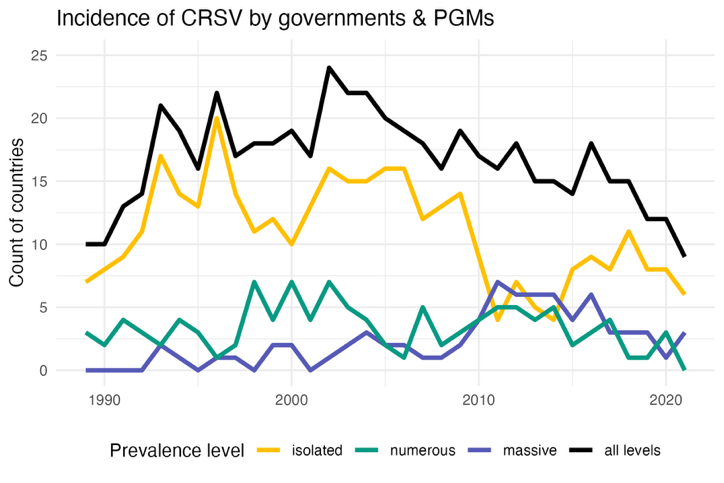
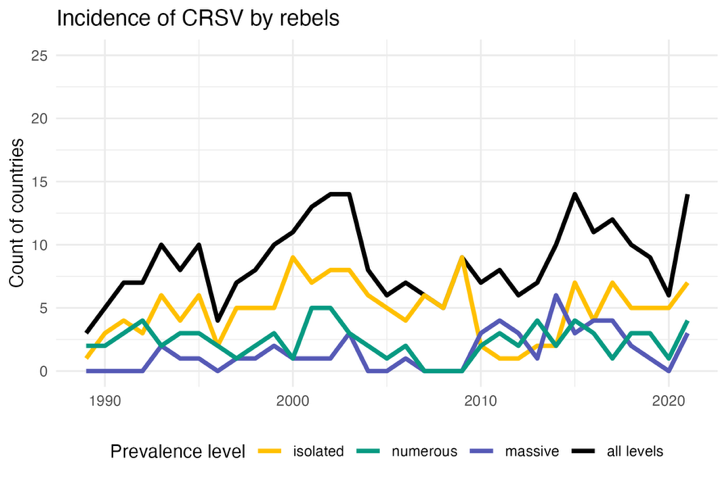
Second, SVAC consistently reports fewer incidents of CRSV perpetrated by rebels than by (pro-)government forces, although rebels’ share of overall CRSV has increased in recent years (see bottom panels). Third, these overall trends mask important differences in the magnitude of CRSV events. Breaking down the overall incidence into prevalence levels (colored lines) demonstrates that isolated and numerous events drove the trends until 2010. Thereafter, isolated events became less common while massive ones became more common. While these prevalence trends are more pronounced for governments and pro-government militias (PGMs), they also apply to rebels.
Meanwhile, by documenting criminal accountability for human rights violations and war crimes for both state agents and rebels, prosecutions data from TJET reveals responsiveness to sexual violence. Trials for CRSV are the focus here, but we will also briefly mention both truth commissions and reparations policies.
Our analysis begins with a subset of “gender-attentive” trials from 1989 to 2023. These are trials that involve human rights violations committed against persons because of their sex and/or socially constructed gender roles. Next, we focus on trials connected to intrastate conflicts, as identified by the Uppsala Conflict Data Program. Of 7,341 trials in our broader, global database, 930 (12.7%) are gender-attentive human rights trials. Of these 930 gender-attentive trials, 415 trials are connected to CRSV, and 351 of these were related to rape. The great majority of CRSV cases involved female victims (317), but the dataset also included victims who are male (16), children (95), LGBTQI+ (2), and unidentified (86). Most of the trials occurred in Europe (232 or 56%), mainly in the former Yugoslavia, and Africa (105 or 27%), which suggests that court systems in these regions innovated and took leadership in prosecuting gender violence. Trials in international, hybrid, or foreign courts made up 28%; the remainder were held in domestic courts.
Where are prosecutions taking place, and who is being tried?
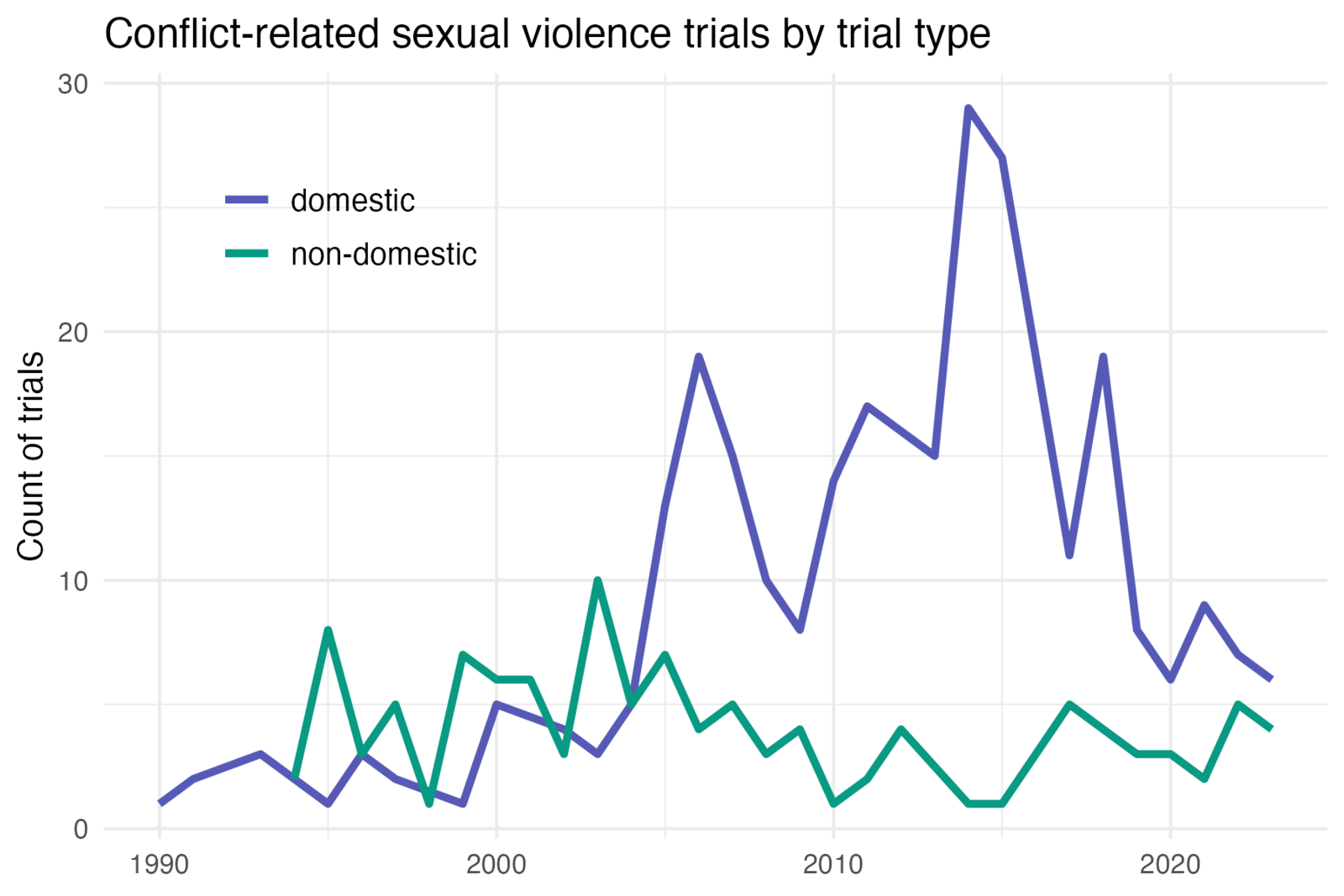
The next figures present our data on the start years of CRSV trials broken down by trial venue and whether the accused was a state agent, including in PGMs, or a rebel. The left-hand panel distinguishes domestic trials from non-domestic (i.e., international, hybrid, or foreign) trials. The first domestic CRSV trial recorded in the TJET data dates to 1990, and the first non-domestic ones appear in 1994. Until 2004, most CRSV prosecutions were pursued in non-domestic courts; after that year, there was a sharp rise in domestic trials, which now outnumbered non-domestic ones.
This surge in domestic trials occurred when overall CRSV incidence decreased but massive CRSV events increased, suggesting that courts became more responsive as the degree and scope of CRSV worsened. This also suggests that while international courts helped bring judicial attention to gender crimes in the 1990s and made important contributions in conflict-affected countries, the greatest potential for criminal accountability lies in domestic courts. The left-hand panel also shows that after 2014, domestic CRSV trials declined again. In other research, the authors of this blog post have found that since 2010, as fewer countries make the transition to democracy and more backslide, the number of all human rights trials has fallen. This trend also affects CRSV trials.
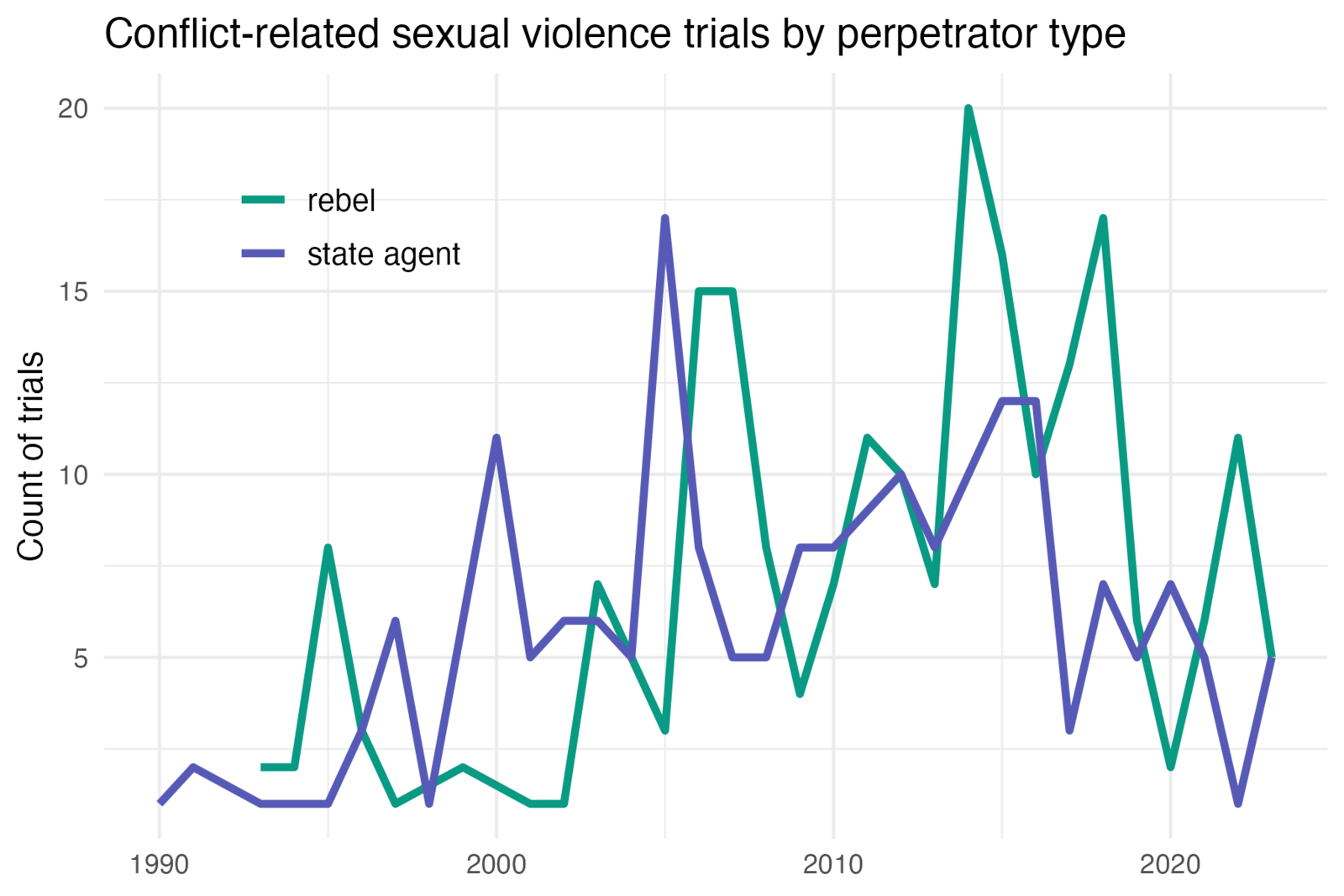
The right-hand panel shows separate trend lines for trials of state agents and rebels. While there were more CRSV trials of state agents overall, those of rebels were not far behind. Considered alongside the SVAC data, which documents similar levels of sexual violence trials in later years, this suggests that CRSV trials may have disproportionately targeted rebels.
Truth commissions and reparations
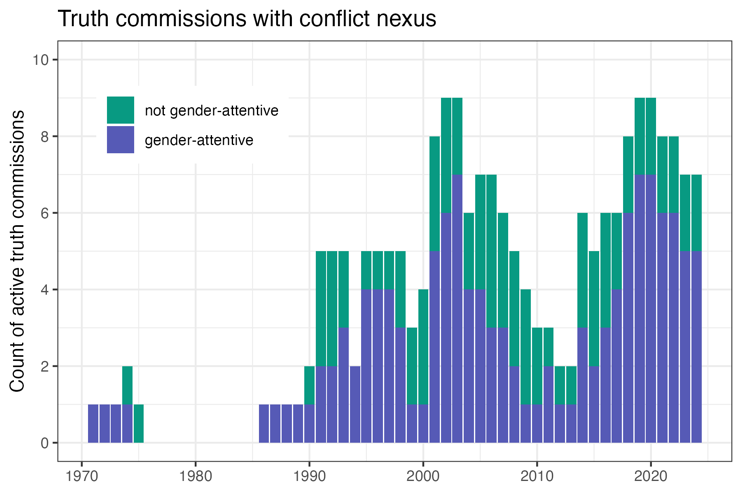
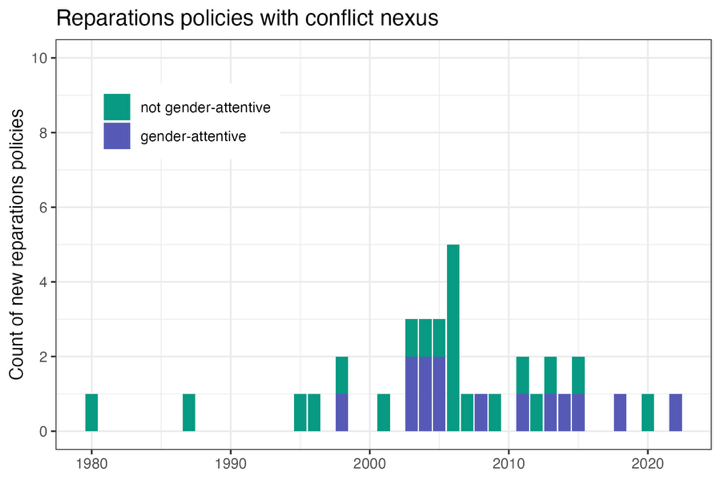
The TJET database also allows us to track the gender-attentiveness of truth commissions (TCs) and reparations policies. For these other TJ mechanisms, we do not have data specific to sexual violence crimes, but it is safe to assume that activities described as gender-attentive in the context of conflict address sexual violence. The left-hand panel of the final figure presents the number of ongoing TCs addressing violent intrastate conflicts. One of the most important findings is the high level of attention paid to gender by truth commissions in countries that experienced conflict. Truth commissions paid much more attention to gender than reparations policies in conflict countries. The right-hand panel shows that, starting in 1998, only 14 out of 35 national reparations policies addressing intrastate conflict were gender-attentive.
What do these data mean for the present and future?
These global trends are just a first cut at examining whether transitional justice has been responsive to conflict-related sexual violence. The data show some limited attention to CRSV and growth in this attention since the 1990s, but they also demonstrate that criminal accountability for CRSV declined more recently. Importantly, the majority of TCs in conflict countries are attentive to gender. Although the 415 CRSV prosecutions we analyzed may appear inconsequential compared to the pervasiveness of sexual crimes during conflict, they nonetheless represent an important increase over the period from 1970 to 1990, when TJ mechanisms gave virtually no attention whatsoever to gender.
But in countries with massive CRSV events, such as the Central African Republic, South Sudan, Sudan, and Syria, TJ initiatives continue to ignore gender. The data examined here point to areas where intervention is most urgently needed—the next step is to find ways of implementing it effectively.